When does fungicide use pay off in maize? Evidence from low foliar disease pressure environments in Southern Brazil
Our study aimed to assess the maize response, in terms of productivity and economic profitability, based on management program with foliar fungicide in the first and second seasons.
A preprint version of this work has been available at here.
Review
To ensure food security for a growing global population, it is essential to increase both the quantity and the nutritional quality of food. Nevertheless, plant diseases remain a significant constraint, compromising these improvements by causing substantial yield and quality losses, particularly through foliar, stem, and root damage across various maize-growing regions globally. Among the most important maize fungal diseases are rusts such as common rust (Puccinia sorghi), tropical rust (Phakopsora zeae), and southern rust (Puccinia polysora), as well as other spot diseases including gray leaf spot (Cercospora zeae-maydis), northern corn leaf blight (Exserohilum turcicum), diplodia stalk and ear rot (Stenocarpella maydis), anthracnose (Colletotrichum graminicola), and southern corn leaf blight (Bipolaris maydis).
Why is this study important?
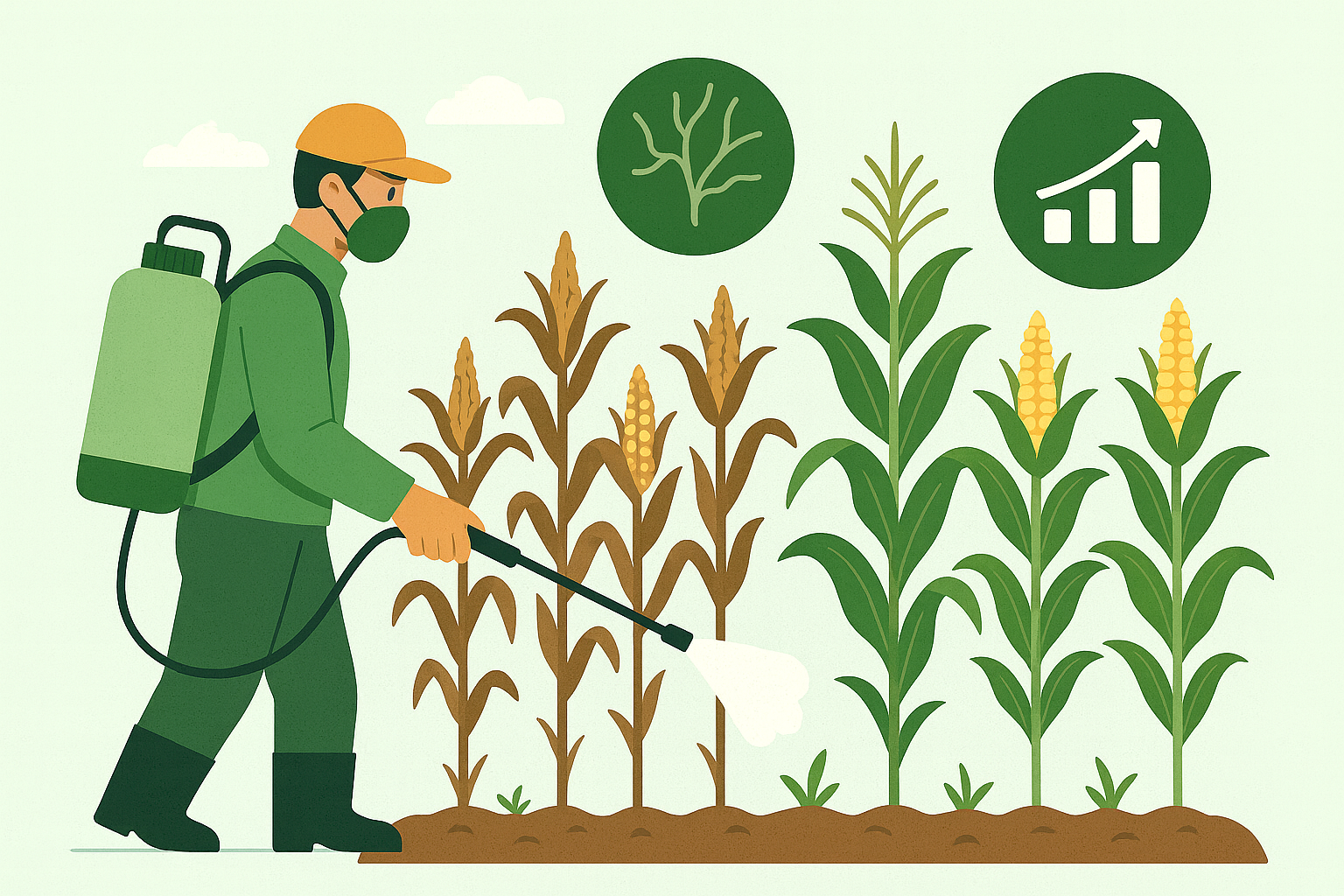
Due to the significant yield reductions observed in maize production, fungicide application has become a widely adopted strategy to suppress disease progression across diverse production areas. However, these strategies may not provide an adequate net return for the farmers when used under unfavorable scenarios.
Who am I?

I’m Ricardo G. Tomaz, a Brazilian PhD Student in Plant Pathology (UFV) and I am doing my PhD Sandwich Program at LSU (EUA). I have strong expertise in crop disease epidemiology, predictive modeling, and yield-loss simulation in crops such as soybean, wheat, and maize. In addition, I have worked with remote sensing to identify and quantify important disease in rice.
Let me know something
📧 ricardo.tomaz@ufv.br